5 November 2026 · 5 min read
Strategy fails in the budget, not in the boardroom
Most strategies never reach the budget. This framework links strategic pillars to funding decisions: score every project on strategic value and delivery complexity separately, review requests all year but fund once a year as a portfolio, and level the ranked list against real delivery capacity. Includes a worked example and a five-level maturity roadmap.
Most organisations have a strategy that looks complete: a handful of strategic pillars (the long-term themes it is built around, such as customers, growth or operational excellence), objectives under each one, perhaps a set of annual OKRs. Far fewer have a mechanism that decides, consistently and defensibly, which project requests deserve capital and operating budget.
Without that mechanism, strategy and budget become two separate exercises. Projects are approved because the sponsor is senior, because they asked first, or because the benefit is easy to put in a spreadsheet. A year later the strategy is still on the wall, but it has quietly stopped steering anything.
This article summarises a framework for closing that gap. It has four linked parts: a strategy cascade, an approval process with real delegated authority, two independent scores for every project, and a capacity check that turns a wish list into a plan. The full white paper, with a worked example, a maturity roadmap and a 90-day starting plan, is available as a PDF below for anyone who has taken the free MaturityPath assessment.
1. A cascade that moves at three speeds
The cascade runs from strategic pillars to objectives, annual OKRs, initiatives and finally projects. The discipline lies in keeping each layer at its own speed. Pillars almost never change. Objectives change slowly. OKRs change every year.
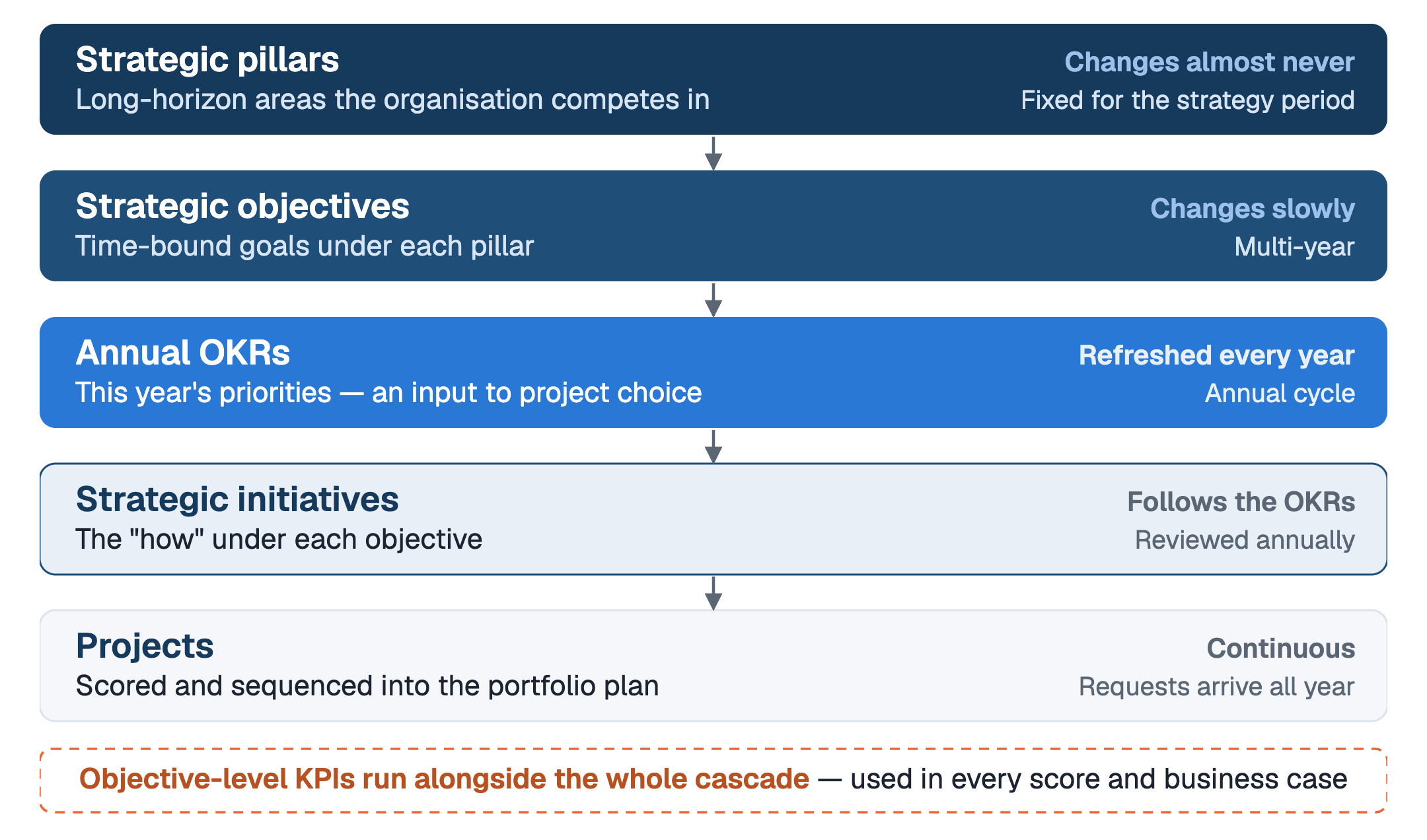
Two details matter more than they appear. First, annual OKRs sit above initiatives and projects, not below them: they are an input that shapes what gets prioritised this year, not a report written after the work is done. Second, objective-level KPIs run alongside the whole cascade. They are the fixed yardsticks every business case uses to show its contribution, not a measurement produced at the end.
2. Review all year, fund once a year
The approval process runs at two rhythms. Throughout the year, each request passes a quality gate: a named Strategic Objective Lead checks its mapping and the justification behind its scores, a cross-functional committee approves it within its delegated authority, and an investment committee reviews feasibility and the business case.
What none of them decides is affordability or timing. That happens once a year, for the whole portfolio together. Approving and funding projects one at a time means an earlier, weaker request can crowd out a stronger one that simply arrived a few months later.
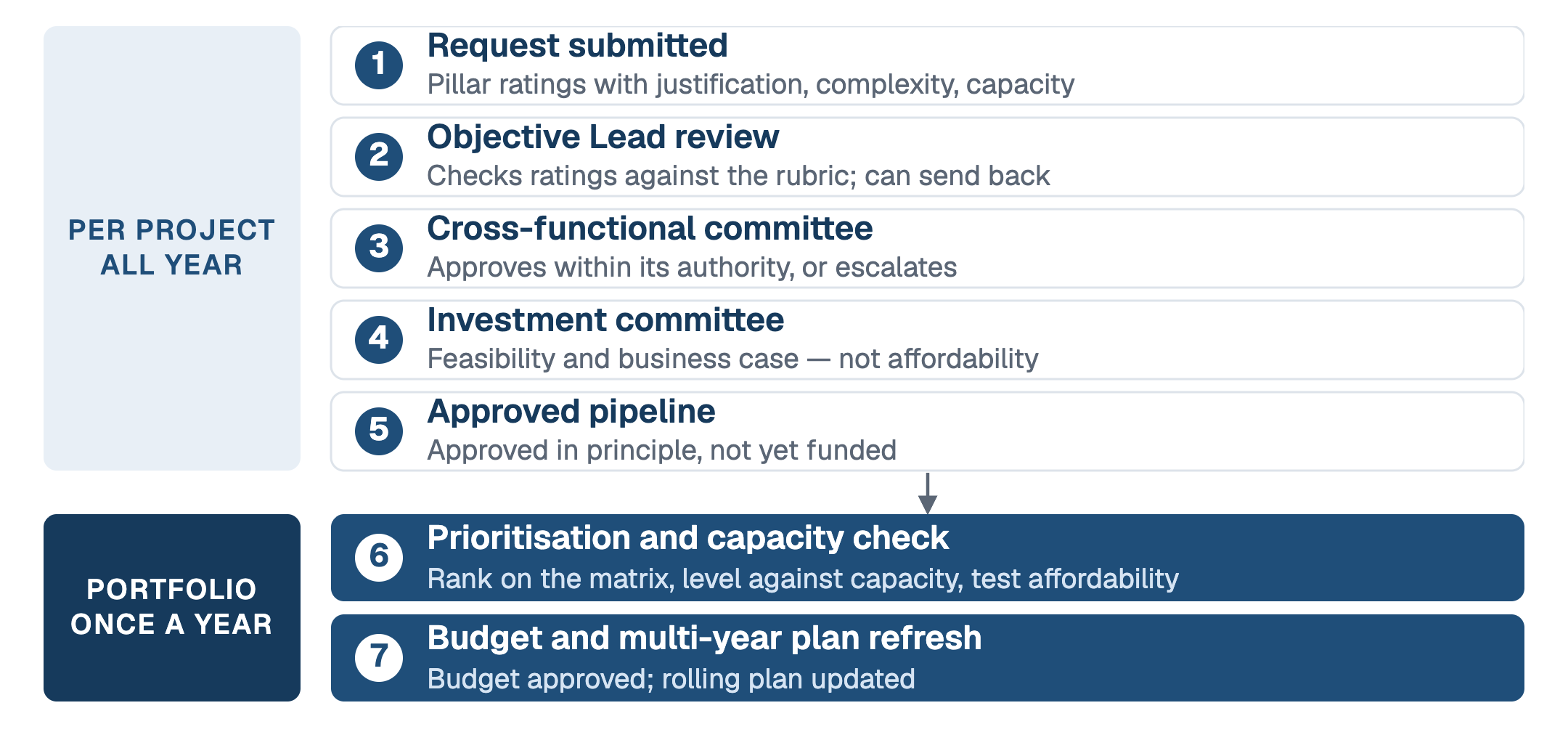
Small, contained requests take a fast-track lane, approved by the function within thresholds set in the delegation of authority and reviewed in aggregate every quarter. Without it, the framework turns into a bureaucracy, and people start splitting projects to get around it.
3. Two scores, never one
Every request is scored twice, and the two scores are never blended.
Strategic value rates the project's contribution to every pillar on a deliberately non-linear scale (None 0, Low 2, Medium 5, High 9, Very high 14), multiplied by each pillar's weight. The primary pillar counts for 70% and the average of the others for 30%. That split rewards focus: very few projects contribute strongly to every pillar, and equal weighting would let projects that touch everything lightly out-score projects that move one pillar a long way.
Implementation complexity averages five factors on the same scale: know-how, capacity and skills, change impact, operational risk and dependencies. A high score here is a warning, not an achievement.
Plotting the two on a 5×5 matrix gives five treatments instead of a single pass or fail:
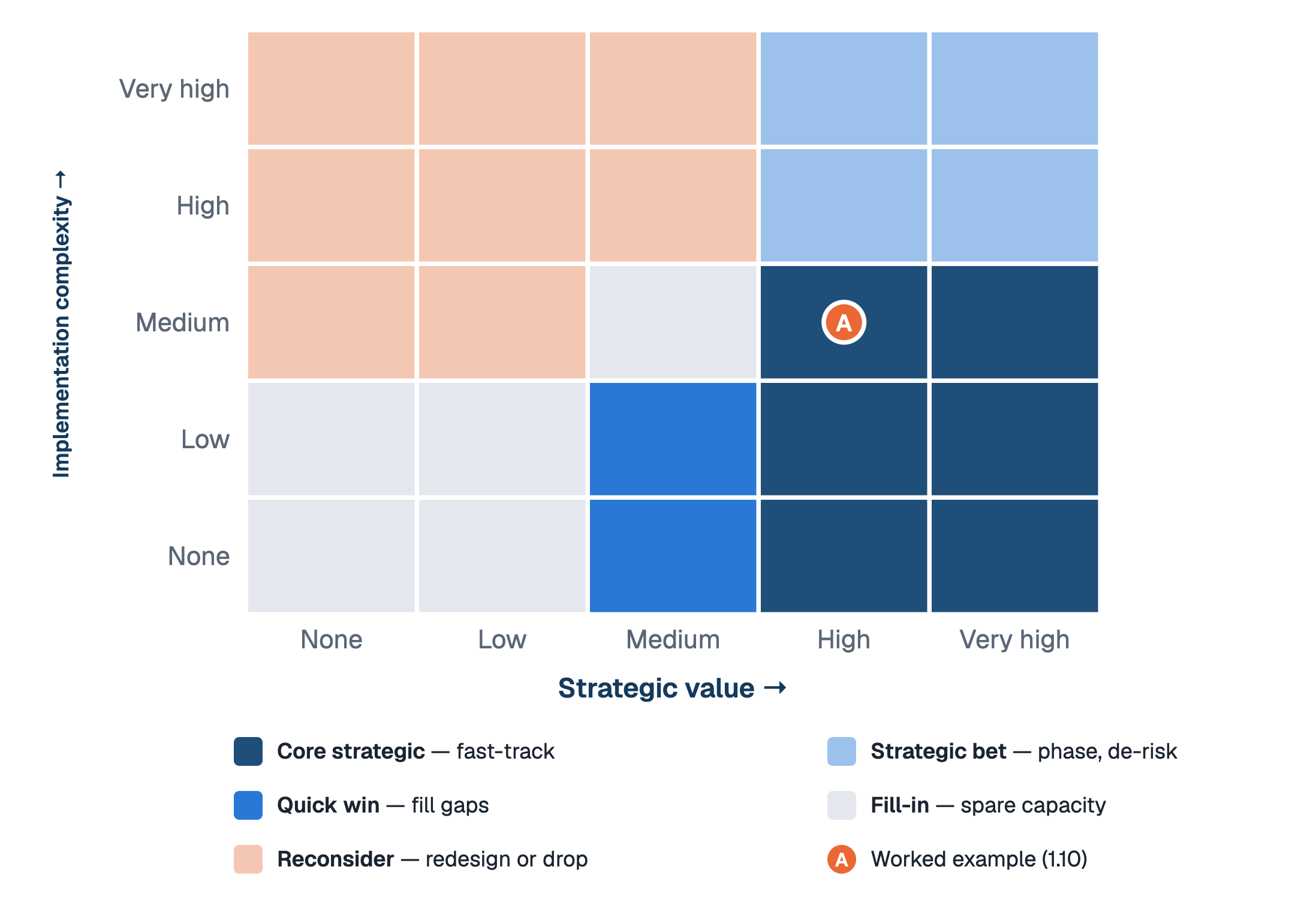
Core strategic — high value, up to medium complexity: fast-tracked into the plan.
Strategic bet — high value, high complexity: approved in principle, then phased or piloted.
Quick win — medium value, low complexity: fills capacity gaps.
Fill-in — low value, low complexity: only if there is spare capacity.
Reconsider — low value with real complexity: redesign or drop.
A quick example: a digital self-service onboarding project rated High on its primary pillar (Customer & Growth, weight 1.2) and Medium and Low on two others scores 8.2 for value — in the High band. Its complexity averages 5.2, which is Medium. That puts it in the core strategic zone. Raise its change impact and dependencies to Very high, and the same project becomes a strategic bet: still worth doing, but not in one go.
Scores only stay honest if they carry evidence. Every rating needs a written justification, checked by someone other than the sponsor against a written rubric. Without that, sponsors soon learn which scores get projects approved.
4. Capacity is its own gate
A ranked list tells you what is worth doing. It says nothing about what can be delivered this year.
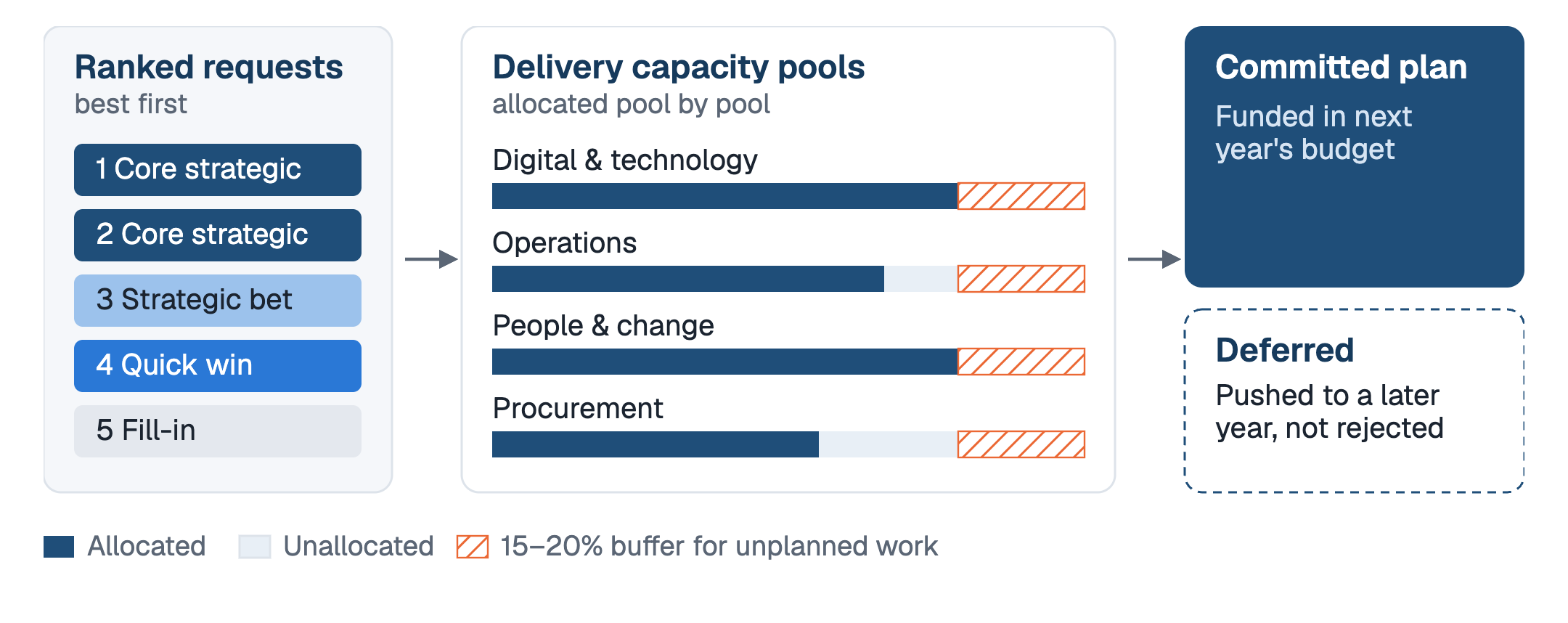
At the annual cycle, the ranked list is walked down a short set of shared delivery pools — digital, operations, people and change, procurement — allocating projects until each pool is full. Overflow is explicitly deferred, and sponsors are told it is deferred, not rejected. A buffer of 15–20% of each pool is held back for the work nobody planned. A top-ranked project can still be sequenced later; strategic merit and deliverability are separate questions.
Where organisations get stuck
The hardest problems are rarely technical:
Committees that can't decide. Authority was implied, never delegated in writing and signed by the executives giving it up.
Going around the process. People go straight to an executive because, at first, it works. Leaders have to redirect every attempt, every time.
Scoring that favours capex. Criteria built by finance default to what finance can measure. Pillar-specific rubrics give operational and customer value a fair hearing.
Weights treated as permanent. The 70/30 split, pillar weights and thresholds are design parameters. Disclose them, test them against past projects and review them on a schedule.
Where to start
A realistic first 90 days: assess where you are and name an Objective Lead for each objective (days 1–30); write the rubrics and back-test the scoring against two or three years of past projects (days 31–60); then pilot the full gate on one objective and gather first capacity estimates (days 61–90). Treat the first full year as calibration rather than a finished state.
Strategy execution sits in the Strategy & Governance area of the MaturityPath model. To see where your organisation stands across all nine areas, start the free MaturityPath assessment. Once you have, the full white paper is yours to download below.