5 November 2026 · 7 min read
Your committees aren't the problem. Trust is.
When every decision ends up with the executive team, the cause is rarely structure. It is trust. This model moves decision rights closer to the work without losing oversight: committees that genuinely decide, a signed delegation of authority, a sunset date for every committee, and a culture change built step by step. Includes an example delegation matrix and a five-level maturity roadmap.
In many complex organisations the same pattern repeats. Committees multiply. Executives spend most of their week in meetings rather than on the work only they can do. And decisions of every size still end up at the top, whatever the organisation chart says.
The usual response is structural: redraw the chart, merge a few committees, publish a new delegation policy. It rarely holds. Within months, decisions drift back upwards, because the structure was never the real problem. Trust was. Executives don't yet trust the people below them to decide, and those people don't trust that a decision they make will stand.
This article summarises a model for fixing both sides. The full white paper, with an example delegation matrix, a maturity roadmap and a 90-day plan, is available as a PDF below for anyone who has taken the free MaturityPath assessment.
How committees take over
Committees are usually created for good reasons: compliance and risk requirements, or technical complexity that specialists need a forum to work through. A large project needs a steering group, and that group is meant to be temporary. Yet long after the project closes, it is still meeting monthly, and nobody remembers why or who has the authority to end it.
Because organisations want these committees to feel important, they invite every executive. Where delegation is thin, executives don't feel able to stay away; they feel expected to be there in person, deciding. The people below them draw the obvious conclusion. If anything above a certain size will reach an executive anyway, why fight for the authority to decide it yourself?
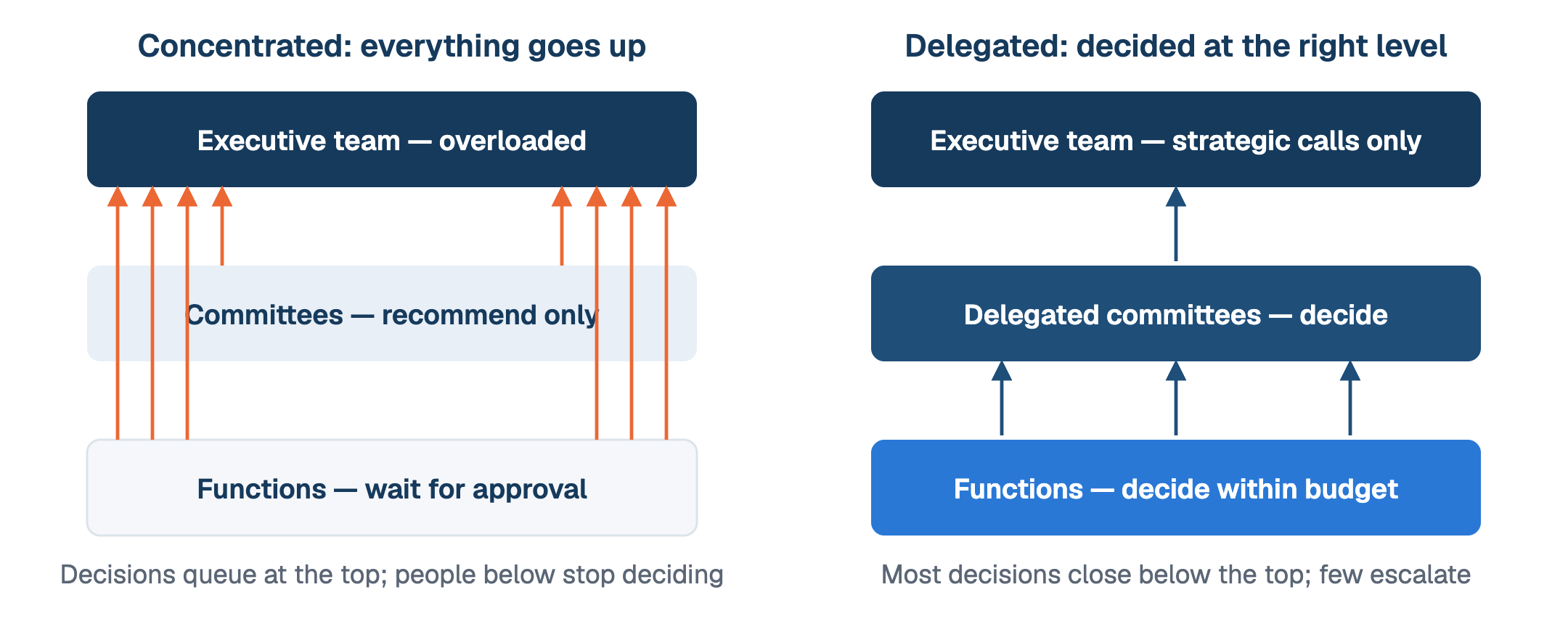
The costs pile up quietly: executive time lost to meetings, succession plans that exist only on paper because nobody below the top has made real decisions, deeper silos because nobody has the standing to force a cross-functional conversation, and a strategy that slows down not because it is wrong but because only a few people can move it.
A committee that outlived its purpose
In one organisation I worked with, the governance model was redesigned, but one committee never retired. Over time it became a talk shop. It had no stated objective, and its membership kept growing until more than 30 people attended. Its three-hour meetings reviewed functional KPIs that were not linked to the strategic KPIs. No decisions were made, nobody owned any action, and the committee had never been connected to the delegation of authority. I recommended retiring it. It survived because the executive who had created it was proud of what it had once been, and the proposed fix was to invite even more people, turning it into something like a town hall with no executives in the room.
That last step is a classic change-management mistake. Large meetings can carry change, but only when the right people deliver the message: the executives who own the “why”, and the line managers who explain what it means for each person. Change practitioners call them preferred senders. A town hall without them informs no one and commits no one. A charter with a purpose, decision rights and a sunset date would have ended that committee, or given it a real job, long before it reached that point.
The hierarchy gap
There is a quieter version of the same problem that is rarely said out loud. Some executives keep a distance of two grades between themselves and the people who report to them. When a direct report is promoted, it is into a role still a grade below the executive, never alongside. It is seldom because those people lack judgement. More often, a capable report who becomes very visible starts to look like a successor, or a rival for the executive's own job. Real influence is kept close, and that person's visibility is quietly capped.
The hierarchy gap can undo delegation even when the policy on paper is sound: a decision right is formally delegated while the real influence stays where it was. The remedy is not to accuse anyone. It is to make decision-making visible, so that who actually decides is as easy to see as who attends.
The fix: delegate for real
Not a slide asking leaders to "empower their teams", but a delegation of authority with teeth:
Committees below the executive layer that decide. Their non-executive members hold real decision rights, and the committee as a group holds slightly more authority than any one member alone.
A signed delegation matrix. Every common decision has exactly one decider, written down and signed by the executives who are giving the decisions up.
Named area owners. They endorse the budget and decisions in their strategic area, which forces them to bring in every function that touches it — the habit that breaks silos.
A charter and an end date for every committee. Purpose, decision rights, who is accountable and who merely attends, and a sunset date. It is the cheapest governance fix there is.
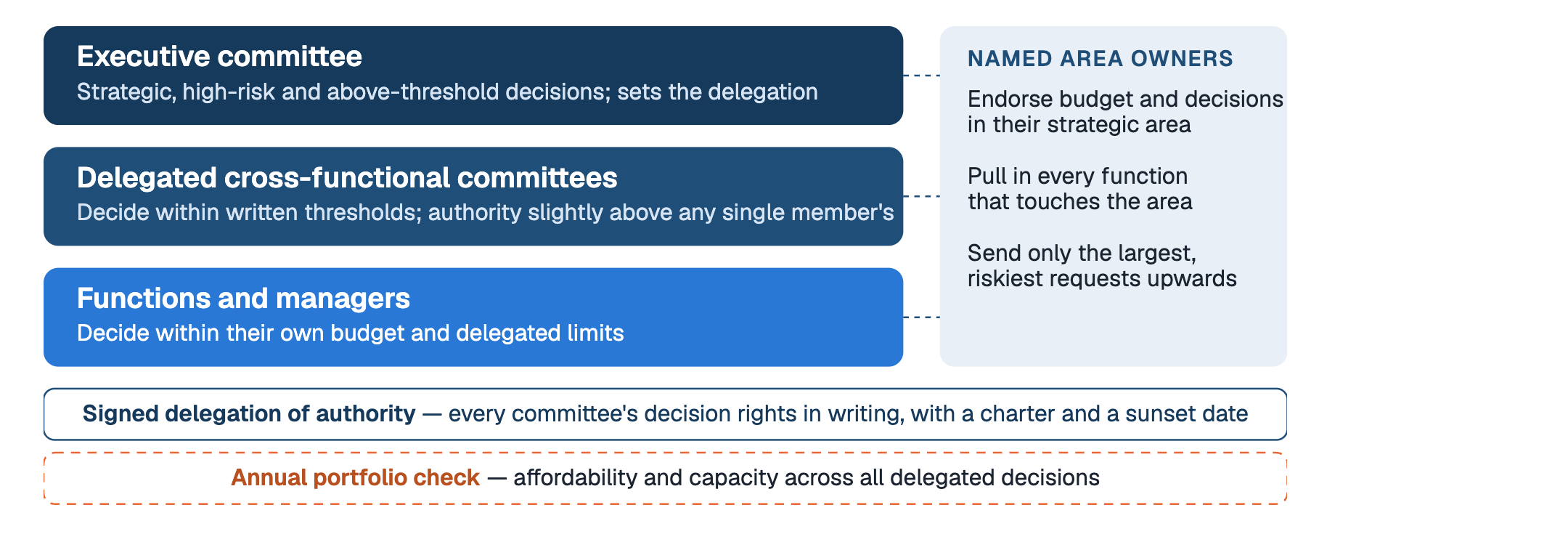
An example makes the point. In one organisation, directors could approve spending up to 100,000 and vice presidents up to 1 million, with nothing in between: anything above 100,000 waited for a vice president. A cross-functional committee of directors could have been given authority up to, say, 300,000 for requests that were not high-risk and did not affect decisions already made. Work would have moved faster, and the directors would have learnt that together they can decide, instead of escalating and waiting.
In practice, a delegation matrix can be as simple as this (the limits are for illustration):
Decision | Who decides | Who else is involved |
|---|---|---|
Within one function's budget, below the director limit | Function lead | Area owner informed |
Cross-functional, not high-risk, below the committee limit | Delegated committee | Area owner endorses; executives informed |
Above the committee limit, or high-risk | Executive committee | Committee recommends; area owner endorses |
One caution. Delegation fixes who decides, not when. If delegated committees approve and fund requests all year, the first request in the queue wins. Keep a single, portfolio-wide affordability and capacity check once a year, as described in our article Strategy fails in the budget, not in the boardroom.
Culture decides whether it sticks
An organisation can rewrite every delegation policy and still watch people quietly route around it to the executive they already trust. Old habits don't dissolve when a new policy is published. The ADKAR change model — Awareness, Desire, Knowledge, Ability, Reinforcement — is a practical way to build the change in the right order.
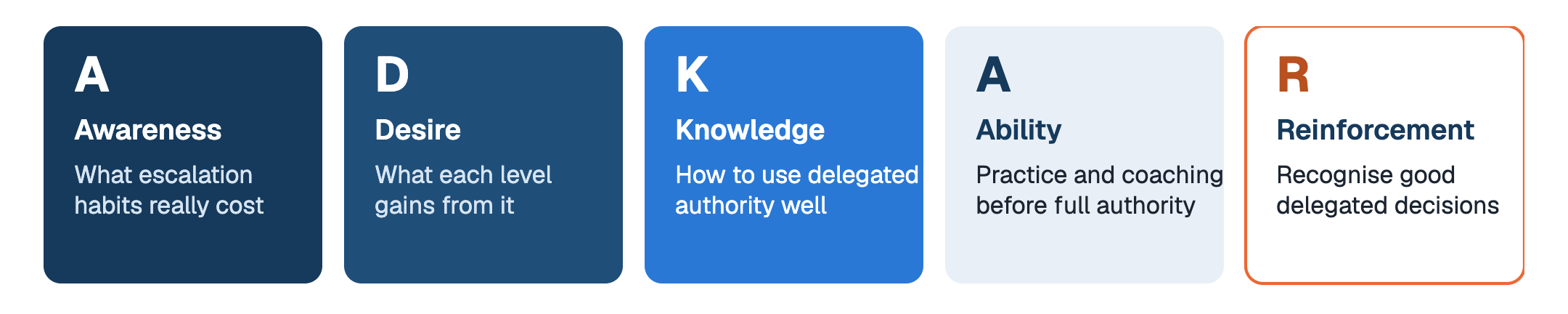
Two stages matter most. Desire has to be specific to each level: executives get their time and a real succession pipeline back; managers get growth and influence; everyone gets faster, fairer decisions. Reinforcement has to include good delegated decisions that didn't fully work out. If the first honest mistake is punished in public, delegation ends that day.
Two situations put extra strain on all of this. In fast-growing companies, headcount grows faster than trust, and governance tends to snap suddenly after a visible failure. In mergers, two trust networks have to become one; expect twelve to twenty-four months, and watch for capable people from the acquired side being quietly bypassed despite their new titles.
How to know it's working
Culture surveys move slowly. These measures move within a quarter:
Decision cycle time: days from a complete request to a decision.
Escalation rate: decisions pushed above the level the matrix assigns. A rising rate points to a trust gap, not a policy gap.
Executive meeting hours: the clearest sign that time is coming back.
Committees retired: how many ended or merged this year.
Where to start
In the first month, inventory every standing committee — purpose, members, hours, decisions actually made — and map where last quarter's decisions were really taken. In the second, draft the delegation matrix and charters with sunset dates, and name area owners. In the third, sign the matrix, retire the first committees and run one delegated committee with full authority and coaching for its members.
Structure can be redrawn in an afternoon. Trust takes far longer, and no delegation policy moves faster than the trust behind it.
Decision rights and governance sit in the Strategy & Governance area of the MaturityPath model. To see where your organisation stands across all nine areas, start the free MaturityPath assessment. Once you have, the full white paper is yours to download below.